 Makan Halal
Hui Cuisine: China's Muslim Culinary Tradition
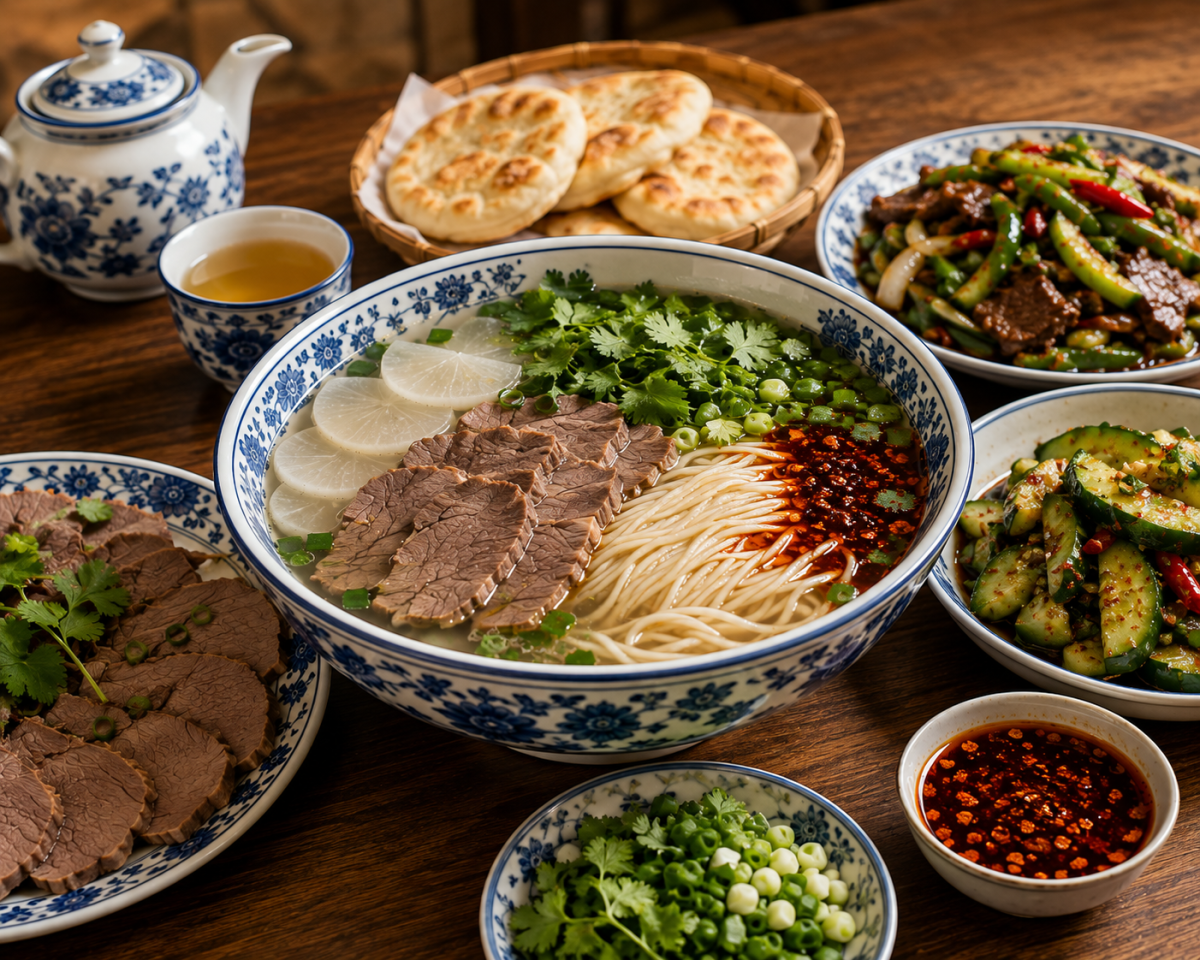
Long before "halal" became a familiar word outside the Muslim world, Chinese Muslims had their own term for it: qingzhen, meaning "pure and true." The phrase still appears on restaurant signboards across northern and western China today, marking kitchens run by the Hui, an ethnic group whose food sits at the crossroads of Chinese and Islamic tradition.
The Hui trace their origins to Persian, Arab and Central Asian merchants, soldiers and scholars who travelled the Silk Road into China between the 7th and 13th centuries. Over generations they settled, intermarried with Han Chinese and other local groups, and adopted Mandarin as their everyday language, while holding onto Islamic dietary law and worship. Today the Hui number close to 10 million people, China's official count for the group, concentrated in Ningxia, Gansu, Qinghai, Henan and Yunnan, with sizeable communities in Xi'an and Beijing as well.
What makes Hui food distinct is less a single dish than a set of substitutions worked into everyday Chinese cooking. Pork, the default meat in most of China, is absent. Beef and mutton take its place, and in the wheat-growing north, noodles rather than rice form the base of most meals. The clearest expression of this is lamian, hand-pulled noodles that Hui cooks in Gansu developed into what is now known internationally as Lanzhou beef noodle soup: a clear beef broth, thin slices of meat, white radish, chilli oil and a scattering of coriander, the noodles pulled and stretched by hand rather than cut. Cumin-crusted lamb skewers, grilled over open coals and known as chuan'r, are another staple, their heavy spicing a legacy of trade contact with Xinjiang and Central Asia further west. Flatbreads such as nang, baked until the crust turns firm and the centre stays soft, round out much of the everyday cooking.
Hui food is often mentioned alongside Uyghur cuisine, and the two are frequently confused, but they developed along different lines. The Uyghurs are a Turkic people from Xinjiang whose cooking carries a stronger Central Asian and Middle Eastern character, built around dishes like lamb pilaf and laghman noodles served with a tomato and pepper sauce. Hui food, by contrast, stayed closer to the broader Chinese kitchen it grew up alongside, leaning on stir-frying, noodle soups and seasonings familiar to Han Chinese cooking, with the dietary substitutions layered on top rather than a wholesale departure from it.
Geography shaped the cuisine further. In the north, where cattle were historically more available in Hui and other minority-run herding regions than in Han-dominated farmland, beef became the everyday protein, and seafood rarely appeared far from the coast. Hui communities that settled in Yunnan, in China's south, took a different path, incorporating duck, goose and river shrimp into their cooking, ingredients that would have been unusual on a table in Gansu or Ningxia.
The tradition has also travelled beyond China's borders. Hui and other Chinese Muslim cooks have opened restaurants in Malaysia and elsewhere in Southeast Asia, where the noodle soups and grilled meats of the Hui kitchen sit alongside a Muslim dining culture already familiar with the dietary framework behind them, giving the cuisine a second life far from where it began.